This excellent YouTube video by Hugh Fearnly-Whittinghall of River Cottage fame looks at the nutritional value of three chicken production types: battery, corn feed and free range. Excellent insights.
Friday, July 24, 2009
River Cottage: Healthy Chicken

Tuesday, June 16, 2009
Major US food & beverage players caught plotting dirty PR tricks over BPA
The chemical bisphenol A, or BPA, used in commerce since the 1950s, is added to plastics to give them strength. It is found in hundreds of household products, including plastic bottles and food containers. It is also present in the linings of canned goods such as soup, baby formula and canned fruits and vegetables. Over the past decade, a growing body of scientific studies has linked the chemical to breast cancer, testicular cancer, diabetes, hyperactivity, obesity, low sperm count, miscarriage and other reproductive problems in laboratory animals. More recent studies using human data have linked BPA to heart disease and diabetes. And it has been found to interfere with the effects of chemotherapy in breast cancer patients.
Manufacturers of cans for beverages and foods and some of their biggest customers, including Coca-Cola, are trying to devise a public relations and lobbying strategy to block government bans of a controversial chemical Bisphenol (BPA) used in the linings of metal cans and lids. According to internal notes of a private meeting, obtained by The Washington Post, frustrated industry executives huddled for hours Thursday trying to figure out how to tamp down public concerns over the chemical bisphenol A, or BPA.
The notes said the executives are particularly concerned about the views of young mothers, who often make purchasing decisions for households and who are most likely to be focused on health concerns. Industry representatives weighed a range of ideas, including "using fear tactics [e.g. “Do you want to have access to baby food anymore?” as well as giving control back to consumers (e.g. you have a choice between the more expensive product that is frozen or fresh or foods packaged in cans) as ways to dissuade people from choosing BPA-free packaging," the notes said.
The attendees estimated it would cost $500,000 to craft a message for a public relations campaign, according to the notes. “Their ‘holy grail’ spokesperson would be a ‘pregnant young mother who would be willing to speak around the country about the benefits of BPA,’” the notes said.
Source: “Strategy Being Devised To Protect Use of BPA” – The Washington Post – 31 May 2009
Despite this, US Congress gives FDA control over soft drinks
The U.S. Senate overwhelmingly passed historic legislation Thursday that puts the soft drink industry under the regulation of the Food and Drug Administration (FDA). Soda companies are weighing the impact of the bill, which they say also puts severe restrictions on advertising and packaging. Former FDA Commissioner David Kessler, who spearheaded the original effort to treat the caffeine in soft drinks as a drug, hailed the Senate vote of 79-17. “It's as strong a bill as we could have ever imagined,” he said. More than 350,000 people die every year from soft-drink-related diseases, according to government figures. About 45 million U.S. adults are regular soda-pop drinkers, though the prevalence has fallen since the U.S. surgeon general's warning 45 years ago that soda drinking causes obesity.
The FDA has announced new regulations, slated to take effect July 1, which will tighten governmental controls over the soda industry. All pop cans will be required to carry a warning of the myriad ill effects which are connected with regular soda-drinking. Soda vending machines will be banned in all schools, hospitals, and public buildings. Children under 18 will be prohibited from purchasing soft drinks, unless accompanied by an adult.
Source: “Congress gives FDA control over soft drinks” – examiner.cpom – 12 June 2009
THOUGHTS: This is a very disappointing insight on the ethics and morales of big food business in the US. Their leaders might be great people one-on-one, but when they pressure comes on, their companies work together like a pack of rats. Forget what's right, what's healthy, what's good for the customer....just focus on the profit. Smells like a big tobacco's PR team involved here.
KEYWORD: Foof, Beverage, Ethics, Health, Corporate, Packacking, PR
Wednesday, June 10, 2009
Robotics: Should war be easy as playing a computer game

Robotics in war is the most important change in major human activity dating back at least 5,000 years, according to P.W. Singer, a senior fellow at the Brookings Institution think tank and the author of Wired for War: The Robotics Revolution and Conflict in the 21st Century.
“Forty-three other countries besides the U.S. build military robots,” he says. “So you have this just huge... immense growth. The best way to imagine where we're going is to look at what Bill Gates says about robotics" He says, "Robotics are about where computers were in 1980.”
Warfare goes open source: Just like software, warfare is going open source. That is, we're starting to use more and more systems that are commercial, off-the-shelf -- some of it is even DIY. You can build your own version of the Raven drone, which is a widely used military drone, for about $1,000 dollars. So we have a flattening of the landscape of war and technology that is just like what happened in software. A wide variety of actors can utilize these systems.
The non-state actors range from Hezbollah to this militia group in Arizona to a bunch of college kids at Swarthmore. It widens the landscape of who can play in war. That's a pretty disturbing factor. One person's hobby -- such as the hobbyist who flew a homemade drone from North America to Great Britain -- can be another person's terrorist strike option.
Source: “Wired For War or How We Learned to Stop Worrying and Let Dystopian SF Movies Inspire our Military Bots” -
An interview with P.W. Singer, author of Wired for War” – hplus magazine – 20 May 2009
http://www.hplusmagazine.com/articles/robotics/wired-war-or-how-we-learned-stop-worrying-and-let-dystopian-sf-movies-inspire-our-
“This is amazing technology,” says Singer, “but it raises disturbing, fascinating questions. On one hand, hundreds of soldiers are alive today thanks to robots. The flip side, however, is that they allow us to use more force with less risk. Eleven out of the top 20 Taliban leaders have been killed by robot drones.”
But the impetus to create a fully-functional, fully-autonomous robot warrior is a political one. Says Noel Sharkey, a professor of robotics and artificial intelligence at Sheffield University “Body bags containing real soldiers coming home affect the government electorally,” says Noel Sharkey, a professor of robotics and artificial intelligence at Sheffield University. “Once you start using robots, you remove this problem.” But do we really want going to war to be as easy, and impersonal, as playing a computer game? And once we have created our indestructible robot armies, will we ever be 100 per cent sure that we can control them?
Source: “March of the terminators” by Gavin Knight – Mail Online – 16 May 2009
http://www.mailonsunday.co.uk/sciencetech/article-1182910/March-terminators-Robot-warriors-longer-sci-fi-reality-So-happens-turn-guns-us.html
THOUGHTS: Very big questions...trouble is I don't see citizens in any country having the opportunity to be part of this ethical debate.
KEYWORDS: Robot, Robot, War, Defence, Conflist, Ethics, Debate, Humanity
Sunday, June 07, 2009
Emerging global reach and sophistication of video surveillance
A couple of interesting recent insights on the emerging reach and sophistication of video surveillance:
Worldwide surveillance camera shipments growing at 45% per year
In its latest report on surveillance technologies, IDC says rapid advancements in network surveillance technology are shifting the emphasis away from guns, guards, gates, and dogs and placing it on “more sophisticated, scalable security solutions,” which the research firm predicts will see worldwide surveillance/monitoring camera shipments grow from 9.3 million in 2007 to 26.5 million in 2013: an average annual growth of 45.0%.
In its latest report on surveillance technologies, IDC says rapid advancements in network surveillance technology are shifting the emphasis away from guns, guards, gates, and dogs and placing it on “more sophisticated, scalable security solutions,” which the research firm predicts will see worldwide surveillance/monitoring camera shipments grow from 9.3 million in 2007 to 26.5 million in 2013: an average annual growth of 45.0%.
Source: “Technology taking over from guns, guards, gates & dogs!” – ITWire.com – 24 May 2009
Next generation of camera surveillance will have imbedded intelligence
Bir Bhanu, director of the Center for Research in Intelligent Systems, said the goal is “to understand the interaction of people from video networks, to figure out their intention.” Bhanu foresees a time, possibly within the next decade, when programs analyzing facial identification, emotional expressions, social interactions and contextual anomalies will be able to alert monitors or law enforcement personnel about someone who may be up to no good. He said a computer system could spot “person who brings a briefcase and does not normally carry a briefcase, or a person who is wearing a jacket in Riverside when it's 100 degrees outside. These simple things can be detected.”
Source: “UCR has eye on surveillance technology” – The Press-Enterprise - 27 May 2009
THOUGHTS: How can we be sure that the needs of state and commerce for pervasive video surveillance do not override the individual's right of privacy? These market signals are reminiscent of the themes expressed in that movie The Minority Report.
KEYWORDS: Democracy, Freedom, Surveillance, Video, Artificial Intelligence
Sunday, March 01, 2009
Residential building with segregated trash shutes for recycling

I ran across a really interesting waste recycling innovation reported in the Las Vegas Business Press. The article reported Rita Brandin, Executive vice president and development director of Newland Communities, as saying:
“It's not only construction elements but the operational ease you create for tenants to recycle. It's about having healthy living systems. For example, we have designed (in Union Park) a (residential) building with segregated trash chutes, so residents can put wet trash in one and what can be recycled in the other.”
THOUGHTS: What a great idea! We already do this for water and sewage. Separating packaging, household and food waste at source seems an obvious next step, for improving waste recycling efficiency and lowering operating (e.g. transport) costs.
KEY WORDS: Waste, Recycling, Building, Sustainability
Thursday, April 24, 2008
Biofuel breakthrough from Texas
 Fantastic news from The University of Texas! Professor R. Malcolm Brown Jr. and Dr. David Nobles Jr. have created a microbe that produces cellulose that can be turned into ethanol and other biofuels. Nobles says that the microbe could provide a significant portion of the nation's transportation fuel if production can be scaled up.
“The cyanobacterium is potentially a very inexpensive source for sugars to use for ethanol and designer fuels,” says Nobles, a research associate in the Section of Microbiology and Molecular Genetics. Brown and Nobles say their cyanobacteria can be grown in production facilities on non-agricultural lands using salty water unsuitable for human consumption or crops.
- The new cyanobacteria use sunlight as an energy source to produce and excrete sugars and cellulose,
- Glucose, cellulose and sucrose can be continually harvested without harming or destroying the cyanobacteria (harvesting cellulose and sugars from true algae or crops, like corn and sugarcane, requires killing the organisms and using enzymes and mechanical methods to extract the sugars),
- Cyanobacteria that can fix atmospheric nitrogen can be grown without petroleum-based fertilizer input.
THOUGHTS: I these guys can really find a way to scale up the efficient and cost-effective production of this cyanobacteria… it could provide a sustainable and global breakthrough for the converging challenges climate change, peak oil and rampant food price rises.
KEY WORDS: Biotechnology, Biofuel, Energy, Peak Oil, Sustainability
Wednesday, August 01, 2007
How about facial recognition from more than two miles away!

I was researching the convergence of various industries (robotics, security, etc) with geospatial trends...and a real wow popped out...from an article back in April 2004. Since then silence:
The U.S. Air Force's Unmanned Aerial Vehicle Battlelab (UAVB) has tested software that can pick desired features out of UAV video long before they become visible to the naked eye, according to Lt. Col. Timothy Cook, chief of the UAVB's Combat Applications Division. Based at Eglin Air Force Base, Fla., the UAVB's mandate is to take existing hardware and weapons and integrate them with UAVs. The recognition software originally was developed for the Nevada gaming industry, to automatically spot problem gamblers when they enter casinos, Cook said. "It's based on the dimensions of your face," he said. "If I trained the camera on your face, it would plot the distance between the pupils of your eyes ... the length of your nose, the width of your mouth."
Intrigued by the possible applications to UAV surveillance video, the UAVB conducted a test last year at Eglin using streaming video from a Pointer UAV. A captain's face was entered into the computer as a search item, and the UAV was launched. "It starts beeping on this clump of trees," Cook said. "And they had to drive the UAV about another two miles before they could get close enough [to see] there was a vehicle underneath the trees." The captain whose face had been loaded into the computer was sitting in his truck eating lunch. "It found his face through the trees, through the windscreen, in the shadows of the trees, and we went, 'Wow, we need to explore this,'" Cook said. While the UAV Battlelab continues to pursue the Digital Imagery and Video Object Tracking software's application to operations, the technology also has found its way into the classified world, Cook said
THOUGHTS: Can you imagine how much more sophisticated the application is now after 3 years. Facial recognition via satellite? It's ironic that such technology might drive male combatants in the Middle East to wearing burqa's.
KEYWORDS: Facial recognition, UAV, intelligence, software
The U.S. Air Force's Unmanned Aerial Vehicle Battlelab (UAVB) has tested software that can pick desired features out of UAV video long before they become visible to the naked eye, according to Lt. Col. Timothy Cook, chief of the UAVB's Combat Applications Division. Based at Eglin Air Force Base, Fla., the UAVB's mandate is to take existing hardware and weapons and integrate them with UAVs. The recognition software originally was developed for the Nevada gaming industry, to automatically spot problem gamblers when they enter casinos, Cook said. "It's based on the dimensions of your face," he said. "If I trained the camera on your face, it would plot the distance between the pupils of your eyes ... the length of your nose, the width of your mouth."
Intrigued by the possible applications to UAV surveillance video, the UAVB conducted a test last year at Eglin using streaming video from a Pointer UAV. A captain's face was entered into the computer as a search item, and the UAV was launched. "It starts beeping on this clump of trees," Cook said. "And they had to drive the UAV about another two miles before they could get close enough [to see] there was a vehicle underneath the trees." The captain whose face had been loaded into the computer was sitting in his truck eating lunch. "It found his face through the trees, through the windscreen, in the shadows of the trees, and we went, 'Wow, we need to explore this,'" Cook said. While the UAV Battlelab continues to pursue the Digital Imagery and Video Object Tracking software's application to operations, the technology also has found its way into the classified world, Cook said
THOUGHTS: Can you imagine how much more sophisticated the application is now after 3 years. Facial recognition via satellite? It's ironic that such technology might drive male combatants in the Middle East to wearing burqa's.
KEYWORDS: Facial recognition, UAV, intelligence, software
Sunday, May 20, 2007
Carbon emissions trading - on the cusp of a boom?
Check out the just published Hill & Knowlton survey of 420 senior execs with USD 100 million plus companies in the United States, UK, Canada and China. It reports that:
- While 82% of the respondents closely monitor the issue of global warming, 65% said that they don’t yet have a defined energy strategy to deal with it.
- 65% said that no one within their organizations is tasked with defining the company’s energy strategy.
- 52% identified improved corporate reputation as the most important return on investment for environmental programs.
- 38% rated actual carbon emission reduction as the most important metric for return on investment for environmental programs.
Further to the above, I also ran across the “Preliminary results for the year ending 31st December 2006” of the Climate Exchange Plc. The Climate Exchange plc operates the world’s largest markets for trading carbon credits; the European Climate Exchange and the Chicago Climate Exchange. The report details a dramatic growth (be it from a low base) in global the carbon trading market…for example CLE chairman Richard Sandor reports:
"The Chicago Climate Exchange (CCX) saw its average daily volume increase by 610% over 2005. Total volume in the Carbon Financial Instrument (CFI) for 2005 was l.4 million tonnes, which grew to 10.3 million tonnes in 2006. For the first quarter 2007, average daily volume increased by 167% over the figure for the full year 2006. Our list of members also grew dramatically. We closed 2005 with 131 members which increased to 238 in 2006."
THOUGHTS: Both these reports signal that despite a sea change jump in global corporate interest in climate change, most businesses have yet to develop coherent strategies to engage the challenge. Those businesses that are acting have focused their reduction strategies around carbon emissions trading (Cap & Trade).
And that the growth in carbon credit trading in the US and Europe is explosive. And clearly the stock markets get it too. Just look at the financial share price rise of Climate Exchange Plc (CLE).

The is great news for the planet!
KEYWORDS: Climate Change, Sustainability, Carbon, Footprint reduction
Tuesday, May 15, 2007
Accelovation’s web crawler agent identifies and matches needs with solutions

An exciting new service offering has just hit the research market. Mountain View, California based company Accelovation has just launched their market-discovery software which crawls the Internet to identify emerging market needs/trends, and potential solutions to meet those needs. In a recent PC World article Jens Tellefsen, vice president of Accelovation products described the service “We will identify any statement that talks about a need for something, or a claim or solution for something. That can be an individual talking about how annoying it is to cook, or to use a particular product, to people that are dying or suffering from some disease . . . to companies that are looking for new ways to do something.”
The initial Accelovation service offering available is not cheap. Customers currently pay between US$50,000 for a few sets of searches to over US$100,000 for annual subscriptions. Accelovation say they already have two dozen customers in the Fortune 500, including 3M, Procter & Gamble, General Mills and Clorox. Speaking of future plans Tellefsen said “We're rapidly moving forward with new offerings that will be more suited to small- and medium-sized companies, and be more automated and packaged in a way that makes sense to them.”
THOUGHTS: An automated needs and solutions search and matching software agent sounds compelling. There could also be an explosive demand for additional matching applications if only Accelovation could make them affordable, to not just SMEs, but individuals. Imagine the convenience and value proposition for consumers of an Accelovation dating or travel planning engine. A sort of yellow pages on steroids? I’m guessing that unfettered success will require Accelovation to move to a “free” model funded by context relevant advertisements like Google’s Adsense service
KEYS WORDS: Search, Research Internet, Trends, Matching, Needs, Solutions, Software, Service, SME, Consumer, AdSense
Tuesday, June 13, 2006
Neuroscience must read for change leaders
Note for strategists and change agents: I make a strong recommendation that you read the article “The Neuroscience of Leadership” by researchers David Rock and Jeffrey Schwartz in the latest Booz Allen Hamilton online magazine Strategy + Business.
In short the authors espouse that: “Managers who understand the recent breakthroughs in cognitive science can lead and influence mindful change." Rock and Schwartz use compelling examples backed by clinical research to offer managers a portfolio of tools to better understand, lead and make change.
Thoughts: Particularly interesting is the discovery of the powerful role that our mental models or dominant logic plays in driving our current perceptions. And the corollary logic that "large-scale behaviour change requires a large-scale change in mental maps."
KEY WORDS: Change; Organisation; Leadership; Organisation; Strategy
Teledildonics and avatar sex
While hunting out emerging future trends and disruptions associated with robots and robotics I ran across a fascinating convergence of virtual reality, artificial intelligence and robotics – avatar sex and teledildonics.
- Sinulate Entertainment offers products which enables people at two distan
 t computers to manipulate electronic devices such as a vibrator at the other end. The emerging field is called ‘teledildonics’.
 - XStream3D Multimedia offers a web game called "Virtually Jenna" in which the player has simulated sex with realistic cartoon of porn star Jenna Jameson.
- Visitors to RedLightCenter.com can adopt virtual characters called avatars and use them to live out their sexual fantasies, including having 'intercourse' with another avatar

Thoughts: At first glance this may all seem a little perverse, but this joining of social, physical and virtual worlds signals yet another play out of the merging of humanity and its own technology. Science fiction has well explored such 'social virtuality' ideas: for example in the movies Total Recall (1990) and The Lawn Mower Man (1992). Some questions arise - will the ability to move from relationship development via email, chat and dating services, to full virtual consummation be good or bad for us? Will it become the safer and even the preferred norm?
KEY WORDS: Avatar; Communications; Internet; Robots; Sexuality; Society; Virtual reality
Wednesday, June 07, 2006
Scenting food packaging drives a new dimension
American company Scentsatonal Technolgies has commercialized a way to allow food grade flavours to be imbedded into plastic packaging materials. Now food manufacturers will be able to entice consumers to their shelf in the supermarket with compelling aromas. As their website says “ScentSational Technologies adds another dimension to your marketing with CompelAroma®. Nothing rivals the sense of smell for making an immediate impression about a product's flavor and freshness.” 
Thoughts: This new aroma packaging technology has potential in markets other than food – Socks Allure, Keyboard sur la Plage and even Book Scents.
KEY WORDS: Food; Packaging; Marketing; Consumer
Saturday, May 27, 2006
Dance of the Internet giants great for consumers
Google have just signed up with the world's largest PC seller Dell, to factory pre-load a suite of Google web and desktop search software on Dell’s PC’s for consumers and some corporate customers. This deal is a real challenge to Microsoft’s decade long dominance of the user experience with software pre loads.
At the same time Yahoo and eBay joined forces in a multi-year deal to counter Google’s rise and Microsoft’s renewed web aspirations. Yahoo and eBay will share search and graphical advertising, online payments, a co-branded toolbar, and the testing of a click-to-call functionality.
Thoughts: This partnering dance of the giants feels like serious competition (= drives innovation) and potentially great for me the consumer. Has the music stopped and is that Microsoft still standing?
KEY WORDS: Software; Internet; Advertising; Innovation
Monday, May 22, 2006
Oil industry ads drive uncertainty stake into heart of climate change debate
A public-policy group financed by oil company Exxon Mobil Corp. and automakers General Motors Corp. and Ford Motor Co began broadcasting two sixty-second ads across 14 US cities last week. The ads challenge the validity of current climate change science. The Competitive Enterprise Institute (CEI), a nonprofit conservative business friendly think tank, have timed the ad campaign to coincide with the release of a documentary called “"An Inconvenient Truth," which is about the threat of climate change that features former Vice President Al Gore. Check out the ads here. The CEI ads defend carbon dioxide as a beneficial natural resource rather than a dangerous pollutant. Each 60-second ad ends with the line, "They call it pollution; we call it life."
It’s hard not to see this CEI action as a cynical continuation of the American Petroleum Institute’s (API) propaganda strategy, which was first exposed by the New York Times in 1998. The New York Times published an API memo outlining a strategy to invest millions to “maximize the impact of scientific views consistent with ours, with Congress, the media and other key a udiences.” The document stated: “Victory will be achieved when…recognition of uncertainty becomes part of the ‘conventional wisdom.’”
Thoughts: My tracking of global warming and climate change science research over the last 2 years signals that humanity’s use of fossil fuels is having a dire and dramatic impact on Earth. When oil industry funded ‘research’ comes up with the exact opposite finding, and seeks to manipulate public opinion, you have to laugh at the absurdity. And cry, because of the power such big oil interests can bring to morph the truth into such self-serving, and environmentally dangerous spin. Having ‘outed’ the lies and deceit of the tobacco industry, it’s now time to uncover the untruths and manipulations of the fossil fuel barons and their political stooges.
KEY WORDS: Sustainability; Climate Change; Politics; Ethics
Sunday, May 14, 2006
How romantic…blue cheese perfume!
You’ve got to give credit to the UK Stilton Cheese Makers Association for pushing the boundaries of industry innovation. They have just launched “ “Eau de Stilton” which it claims to "recreate the earthy and fruity aroma" of the pungent blue cheese "in an eminently wearable perfume". Apparently Shazia Awan, 24, of Manchester agreed to try the scent for a day. And she reported that none of her office mates complained.
Thoughts: It’s actually not as strange as you might think. In author Patrick Suskind’s bestselling novel “Perfume : The Story of a Murderer”, the abominable 18th Century French hero Jean-Baptiste Grenouille wove a mixture of rat mouse droppings, cats urine and sweat into a perfume of invisibility.
KEY WORDS: Lifestyle, Marketing, Milk
Friday, May 12, 2006
Bush’s Watergate?
The scale of the USA Today’s exposure of the US National Security Agency’s (NSA) confidential tracking of the phone calls of tens of millions of Americans, ‘authorized’ by a secret Presidential executive order - is breathtaking. The content of the calls has not been recorded. Rather the NSA has been collecting and using call data to “analyze calling patterns in an effort to detect terrorist activity.” The tracking began shortly after ‘9/11’ when three major telcos – AT&T, Verizon Communications Inc. and BellSouth Corp. starting handling over customers' phone calls records to the NSA. Apparently one big telecommunications company, Qwest Communications International Inc., has consistently refused to turn over records to the NSA, citing privacy and legal concerns. Washington is going ballistic. Senior Democrats and Republicans are screaming blue murder.
Thoughts: Shades of Watergate and impeachment in the air. In peacetime this phone tracking of millions of citizens would be outrageous. But at a time of this ‘War on Terror’ where should you draw the line, when you are trying to protect your own citizens? When combined with recent exposures of secret CIA prisons and abuses in Iraq, the unfolding picture is one of a completely unfettered security apparatus. And you have to assume that the press is only seeing a fraction of the secret picture. So the question is – when does Bush push America across the spectrum line of defending the principles of democracy to becoming itself a totalitarian state? I think this did it.
KEY WORDS: Democracy; Politics; Security; Globalisation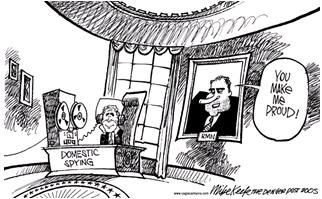
Tuesday, May 09, 2006
Global wine bust and boom
A recent 2005 Deloitte Wine Industry Benchmarking Survey shows Australian wine export prices are down by a massive 33% since 2002 and 40% of Australian wineries are making losses. "The Australian Bureau of Statistics reports the average selling price of Aust ralian wine exported in January 2006 was just $3.78 per litre. The Australian Business Weekly (subscription required) summarises the problems in their May 4th article “Wine: The grape squeeze”:
- Production of wine exceeding demand.
- Panic selling by inexperienced growers.
- Strong $AUD making exports less competitive.
- Retail consolidation hurting boutique wineries.
- Slow growth of 2-3% a year in domestic demand due to high tax on alcohol.
- Poor understanding of demand trends.
- The number of wine companies growing from 892 to 2000 in the past decade.
Thoughts: This boom and bust is very tough on the rapidly growing number of small wineries which lack cost scale, and very challenging for the volume producers of average wine. The strength and growth of the US market will eventually pull the Australasian industry out of trouble…there will be a whole lot less boutique players in the game by then. For consumers operating on the ‘24 hour cellar’ this wine bust will be great news for the next few years. Pass the bottle!
KEY WORDS: Wine; Globalisation; Lifestyle
Thursday, May 04, 2006
Anticipation goes mainstream
A Milwaukee based business group called “The American Society for Quality” has run a survey of 62 selected international business executives s to identify six leading factors shaping the future. Intended as a tool to prompt business execs into developing adaption strategies, the selected six in priority of importance are: Globalization, Innovation/creativity/change, Outsourcing, Consumer sophistication, Value creation, and Changes in quality. 
Writing of the top six, John Schmid of the Milwaukee Journal Sentinel comments. “What's interesting are the topics that didn't rise into the top six: the aging of America, global warming and various geopolitical factors and medical advances.”
Thoughts: Have you noticed that over the last year words like future, trends, scenarios, uncertainty have increasingly crept into both business and lifestyle language. This business of anticipation has moved from the realm of magic to mainstream.
KEY WORDS: Trends; Strategies; Future; Anticipation
Wednesday, May 03, 2006
Coffee gets us to yes
At last some research that supports my coffee habit. Some Australian resea rchers have found that “a caffeine hit improves our increases our ability to scrutinise the content of a message and increases the extent to which we listen to and take on board a persuasive message.”
Advertisers will perk up on this news…but apparently there is a downside: excessive coffee will lead us into a distracted state. So “if you're looking at an advertisement you may be more distracted by the attractiveness of the person selling it than the actual product."
Thoughts: Food; Augmentation; Advertising
Tuesday, May 02, 2006
The most important speech of his life
Every time I fill my car's petrol tank I wonder how bad the current situation can get? Peak oil advocate Michael C. Ruppert has just made a speech in New York to the conferenc e on Local Solutions to the Energy Dilemma titled “The Paradigm is the Enemy – The State of the Peak Oil Movement at the Cusp of Collapse”. On his website Ruppert rates this speech as the “This is the most important speech of my life.”
You will be shocked by it. But there is no doubt there he has built a compelling argument founded in a deep understanding of the unfolding geopolitical dynamics surrounding fossil fuel. It’s definitely worth reading – a powerful tool to test your own assumptions about the current(?) energy crisis. Ruppert quotes his friend Dr. Faiz Khan, “A paradigm is what you think about something before you think about it.”
Subscribe to:
Posts (Atom)


